
99% of People Over 40 Have a Rotator Cuff 'Abnormality' on MRI
Feb 23, 2026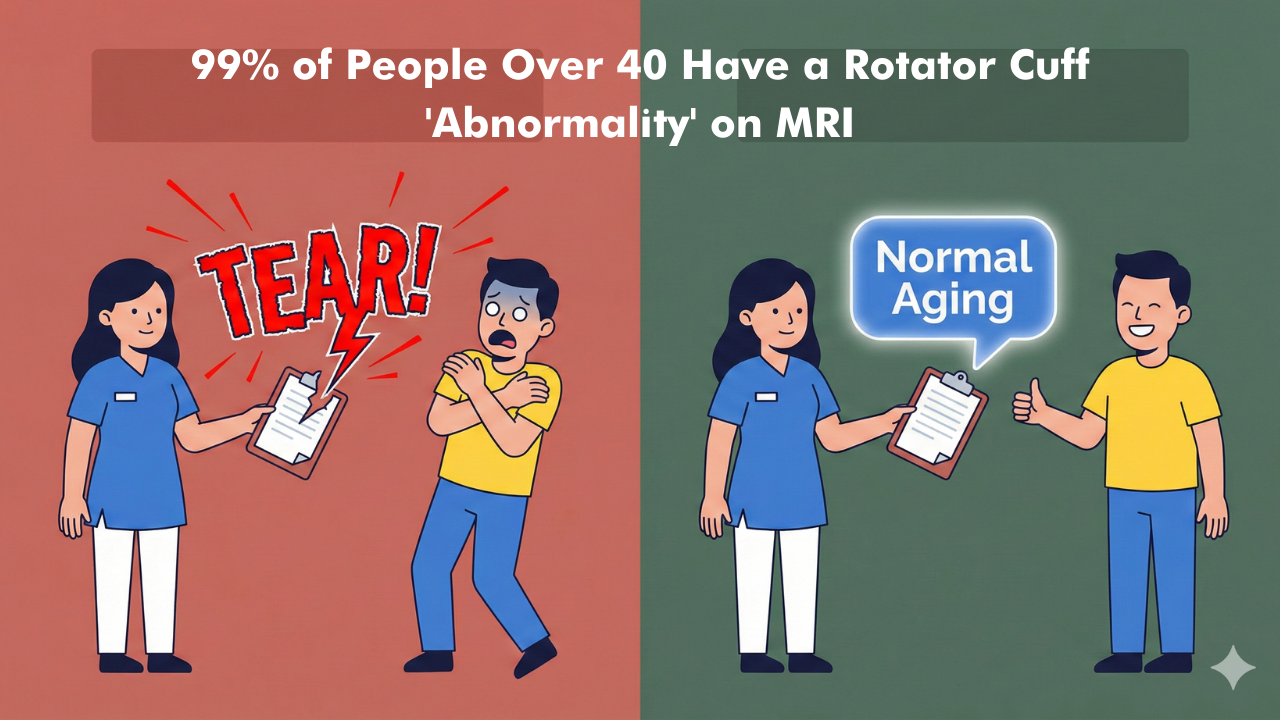
The FIMAGE study was published in JAMA Internal Medicine in February 2026. It scanned 602 people from the general Finnish population with bilateral 3T MRI (very powerful) of both shoulders. Participants were aged 41 to 76 and randomly selected irrespective of whether they had shoulder pain.
98.7% had at least one rotator cuff abnormality. Only 7 out of 602 (1%) had normal tendons in both shoulders. 62% had partial-thickness tears. 11% had full-thickness tears. Most of these people had no shoulder pain.

Where Were the Abnormalities?
Abnormalities were seen across all four rotator cuff tendons: supraspinatus (98%), infraspinatus (86%), subscapularis (83%), and teres minor (11%). Interobserver agreement between the radiologists was near-perfect.
The Key Comparison
Of 492 pain-free participants, 96% had rotator cuff abnormalities on MRI. Of 110 participants with painful shoulders, 98% had abnormalities. A 2% difference. The MRI could not meaningfully distinguish a painful shoulder from a pain-free one.
What About Full-Thickness Tears?
Full-thickness tears were initially more common in symptomatic shoulders, 14.6% versus 6.5%. But after adjusting for two confounders (other imaging findings and clinical examination results), the difference dropped to 0.8%, with a confidence interval crossing zero.
78% of all full-thickness tears in the study were found in asymptomatic shoulders. Among the 26 participants with bilateral full-thickness tears, 65% reported no symptoms in either shoulder. Most people with full-thickness tears had no idea they had them.
A Rite of Passage
The prevalence and severity of rotator cuff changes increased with each decade of life. Normal tendons were present in around 15% of female shoulders and 8% of male shoulders in the early 40s. By the mid-50s, normal tendons had essentially disappeared. Full-thickness tears climbed from near-zero before age 45 to roughly 29% by the 70s. No meaningful difference between sexes.
Developing structural changes in the rotator cuff appears to be part of healthy ageing. The authors compare these findings to grey hair and wrinkles; visible, universal, and in many cases unrelated to pain.

What This Means for Clinicians and Patients
When the baseline prevalence of an MRI finding approaches 100%, the finding has almost no diagnostic value. A 55-year-old presents with shoulder pain. You order an MRI. It shows a partial-thickness tear. The FIMAGE data tells us that around 60% of all 55-year-olds have the same finding, most of them pain-free. The MRI simply described normal ageing.
Even combining 3T MRI with clinical examination by experienced shoulder surgeons could not reliably distinguish symptomatic from asymptomatic shoulders. The question can no longer be ‘is there a tear?’ because there almost certainly is. The question is whether that tear has anything to do with why this person is in front of you.
Words Matter
The word "tear" implies trauma and a need for repair. The authors advocate for terms like "structural alteration" or "age-related change." How we label findings shapes how patients think about their body and what they consent to.
Rotator cuff repairs have increased 2- to 7-fold across high-income countries. Imaging-guided injections have risen 46-fold in Australia since 2000. When findings get treated as diagnoses, interventions follow.
The Takeaway
Routine imaging for atraumatic shoulder pain in people over 40 may be doing more harm than good. Be judicious in your use of scans and ask whether it will materially change your management plan.
The Complete Clinician
Tired of continuing education that treats clinicians like children who can’t think for themselves?
The Complete Clinician was built for those who want more.
It’s not another lecture library, it’s a problem-solving community for MSK professionals who want to reason better, think deeper, and translate evidence into practice.
Weekly research reviews, monthly PhD-level lectures, daily discussion, and structured learning modules to sharpen your clinical edge.
Join the clinicians who refuse to be average.

